There are some data suggesting an interaction of propranolol with central (4) as well as peripheral serotonergic mechanisms (5,6). Since it is commonly accepted that serotonin plays a role in the regulation of blood pressure (7,8), an involvement of serotonergic mechanisms in the action of propranolol cannot be excluded. Among others, the regulation of blood pressure by serotonin involves extensive release of renin and aldosteron (8-11) and such effect is attenuated by ketanserin, a serotonin 5-HT2A receptor antagonists (12).
In the cardiovascular system, the highest concentration of 5-HT is found in blood platelets. Platelets are also capable of stimulus - coupled release of 5-HT and they contain 5-HT2A receptors. Since these elements show similarities with that in other cells, the blood platelet is considered a good model to study the serotonergic system (13).
Taking the above into account, the present study was designed to investigate the influence of propranolol on serotonergic mechanisms in platelets derived from rats with high-renin renal hypertension and normotensive animals.
Animals and induction of renovascular hypertension
The experiments were performed on male Wistar rats weighing between 250 and 350 g. The study protocol was approved by the Local Ethical Committee. Procedures involving animals and their care were conducted in conformity with the institutional guidelines that are in compliance with national and international laws and Guidelines for the Use of Animals in Biomedical Research (Thromb Haemost 1987; 58: 1078-84).
Two kidney, one clip (2K1C) model of renovascular hypertension was induced by a partial, standardised clipping of the left renal artery as previously described (14). All rats subjected to kidney ischemia developed hypertension. The systolic blood pressure (SBP) increased from 128.5±1.2 mmHg to 162.1±2.0 two weeks after the surgery and then plateaued for at least 56 days (data not shown). Therefore, the starting point for all experiments with propranolol was set on the 14th day after the kidney artery stenosis. In sham-operated rats (SO) the same surgical procedure was applied except for the clipping of renal artery, resulting in no significant changes in SBP (data not shown).
Drug administration, SBP measurements and blood sampling
Propranolol was dissolved in distilled water and administered intraperitoneally in a dose of 5 mg/kg once daily for 28 days. The dose was selected from a dose - response experiment as the lowest one producing a significant hypotensive effect in SO and 2K1C animals in the 7th day of administration (data not shown). Control animals received equal volume of vehicle.
SBP was measured in conscious rats using a “tail-cuff” method (Student Oscillograph, Harvard Rat Tail Blood Pressure Monitor) (15). The measurements were performed before the first administration of propranolol and in the 7th, 14th and 28th day of observation. Each value was the average of three consecutive readings performed within a short period of time, 30 minutes after the injection of the drug or vehicle.
In the 7th, 14th and 28th day of propranolol administration, a part of animals from SO and 2K1C groups was sacrificed to obtain the blood for laboratory testing. The blood was sampled under pentobarbital anaesthesia (45 mg/kg, i.p.) by an intracardiac puncture and mixed with 3.13% trisodium citrate (v/v ratio 9:1).
Whole blood 5-HT concentration assay
Whole blood 5-HT concentration was measured using spectrophotofluorometric method (16). In brief, 4 mL of deionised water was added to 1 mL of whole blood and the samples were left for 10 minutes to allow blood cells lysis. Thereafter, 1 ml of 10% zinc sulphate and 0.1 mL of 20% sodium hydroxide were added and the samples were centrifuged by 960 g for 15 min. 4 mL of the supernatant was mixed with 2 ml 3N hydrochloric acid and 0.05% ascorbic acid and serotonin concentration was determined using Nova V2.1 spectrophotofluorometer (Great Britain) with excitation / emission wavelengths set to 360/475 nm.
Platelet 5-HT concentration
Blood platelet 5-HT concentration was measured according to Drumond and Gordon (17). The blood was centrifuged at 490 g for 2 minutes and platelet - rich plasma (PRP) was collected. Platelets were counted using Picoscale counter (Unitra-Biazet, Poland) and their concentration was adjusted to 4 x 10⁸ mL-1 by dilution with autologous platelet - poor plasma (PPP), obtained by centrifugation of the remaining blood at 490 g for 20 minutes.
1 mL of the platelet sample was mixed with 5 mL of deionised water, left for 10 minutes to allow cell lysis and the proteins were precipitated with 2N trichloroacetic acid (TCA). The samples were centrifuged at 960 g for 15 minutes and 1 mL of the supernatant was added to 4 mL of a mixture of o-phthaldialdehyde with 2 mL of 8N hydrochloric acid. Subsequently, the sample was placed in boiling water bath for 10 minutes, chilled on ice and washed twice with chloroform. The concentration of the amine was measured using Nova V2.1 spectrophotofluorometer with excitation and emission wavelengths set to 360 and 475 nm, respectively.
Uptake of 5-HT by platelets
The uptake of 5-HT by platelets was measured using 14C - labelled amine (18). After preincubation of 1 mL PRP (4 x 10⁸ platelets per mL) at 37°C for 5 minutes, 1 µM 14C-5-HT (50-62 mCi/mmol, Amersham, USA) was added and the reaction was terminated after 10 s with chilled 0.4% EDTA in isotonic saline. The samples were immediately centrifuged (10000 g for 40 sec), the supernatant was discarded and the tubes were rinsed twice with 1 mL of ice-cold EDTA-saline. The platelet pellets were solubilized in 0.5 mL of Soluene-350, resuspended in 10 mL of scintillation mixture (PCS, Amersham, USA) and their radioactivity was counted for 1 min (Isocap 500). The rate of 14C-5-HT accumulation in the platelets was expressed in pmol/108 platelets/min.
Platelet aggregation
The assay of platelet aggregation was carried out according to Born and Cross (19). Samples of PRP were preincubated in an Elvi 840 aggregometer at 37°C for 2 min with continuous stirring (900 rpm) before the addition of an aggregating stimulus (2 µM adenosine diphosphate, ADP or 2 µM ADP with 10-8M 5-HT). Changes of light transmission through the sample were registered using two channel TZ4260 Line Recorder (Laboratorni Pristroje Praha, Czech Republic). The results are presented as the percentage of the maximal light transmission in relation to PPP.
Drugs and chemicals
Propranolol was purchased from Polfa Warsaw (Poland). Serotonin (5-hydroxytryptamine creatinine sulphate), ADP, EDTA, TCA and o-phthaldialdehyde were obtained from Sigma, USA; Soluene-350 tissue solubilizer was purchased from Packard, USA; the remaining substances were purchased from Polish Chemical Reagents.
Statistical analysis
Results are expressed as the mean ± standard error mean (SEM). Mann - Whitney U test was used for statistical comparisons. A value of p<0.05 was taken as a level of statistical significance.
Administration of propranolol significantly reduced SBP in both SO and 2K1C rats. After 7 days of treatment, SBP in normotensive animals decreased from 125.8±1.7 to 119.3±1.6 mmHg (p<0.01), while in 2K1C animals SBP was reduced from 162.9±1.4 to 152.1±2.2 mmHg (p<0.01). After 2 weeks of the drug administration further decrease of SBP was observed, and SBP remained on similar level until the 4th week of the experiment (Table 1).
| Table 1. Systolic blood pressure (SBP) in sham-operated (SO) and two kidney - one clip (2K1C) renal hypertensive rats given propranolol (PRO) or vehicle (VEH). ** p<0.01, *** p<0.001 vs initial SBP (day 0). | |||||||||||||||||||||||||
|
In drug-naive SO animals, whole-blood 5-HT concentration after 7 days of observation amounted to 525.5±6.2 ng/ml and it remained unchanged until the end of experiment (Figure 1). Propranolol caused a significant increase in this parameter after 7 days of treatment (580.1±8.3 ng/mL, p<0.05 vs respective control), but not in the 14th or 28th day of drug administration. In vehicle-treated 2K1C rats whole blood 5-HT concentration was significantly lower than that in SO animals (p<0.05) and it decreased with time, reaching 408.5±3.3 ng/ml in the 28th day of observation. Propranolol markedly increased this parameter on the 7th, 14th and 28th day of treatment.
Platelet 5-HT concentration in untreated normotensive rats amounted to 748.6±7.8 ng/109 platelets in the 7th day and it remained similar through the whole observation (Figure 2). In vehicle-treated 2K1C rats the concentration of 5-HT in platelets in the 7th day was significantly higher than in normotensive animals (780.2±2.8 ng/109 platelets, p<0.05 vs SO+VEH); in the 14th and 28th day it decreased to 754.1±8.3 and 703.2±3.9 ng/109 platelets, respectively, and the latter value was significantly lower than that in SO animals (p<0.01). Propranolol decreased platelet 5-HT concentration both in SO and 2K1C rats; this effect was apparent after one week of drug administration and lasted until 28th day of treatment.
 |
| Figure 1. Whole blood 5-HT concentration in sham-operated (SO) and renal hypertensive (2K1C) rats treated with propranolol (5 mg/kg) or receiving vehicle. *** p<0.001 vs vehicle; n=8-10 in each experimental group. |
 |
| Figure 2. Platelet 5-HT concentration in sham-operated (SO) and renal hypertensive (2K1C) rats treated with propranolol (5 mg/kg) or receiving vehicle. *** p<0.001 vs vehicle; n=8-10 in each experimental group. |
The uptake of the amine by platelets from SO rats in the 7th day equalled to 143.1±6.1 pmol/108 platelets and remained unchanged until the end of the observation (Figure 3). Platelets from the 2K1C animals showed lower ability to accumulate 5-HT (92.1±5.8 pmol/108 platelets, p<0.01 vs SO; 84.0±5.3 pmol/108 platelets, p<0.001 vs SO; 72.4±3.9 pmol/108 platelets, p<0.001 vs SO; in the 7th, 14th and 28th day, respectively). In SO animals, propranolol decreased 5-HT uptake beginning from the 7th day of administration and this effect persisted until the end of the experiment. In rats with kidney artery stenosis no significant action of propranolol on platelet 5-HT uptake was observed.
ADP induced aggregation of platelets derived from normotensive animals as well as from rats with Goldblatt hypertension (Figure 4). 5-HT (10-8M) significantly intensified ADP-induced aggregation in both groups (p<0.05-p<0.001). The maximal aggregation induced with ADP or ADP+5-HT did not differ between particular time-points inside experimental groups. The aggregation of platelets derived from 2K1C animals was markedly increased in comparison with normotensive animals (p<0.05-p<0.01). Both in SO and 2K1C propranolol significantly inhibited potentiation of ADP - induced platelet aggregation by 5-HT.
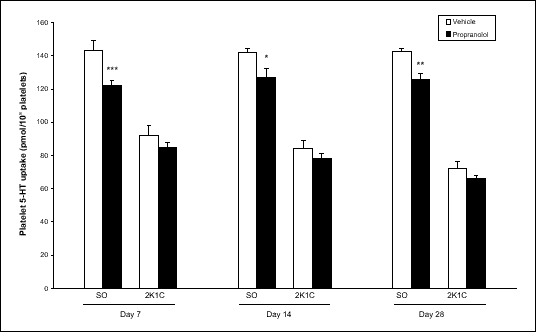 |
| Figure 3. 5-HT uptake by platelets derived from sham-operated (SO) and renal hypertensive (2K1C) rats treated with propranolol (5 mg/kg) or receiving vehicle. * p<0.05, ** p<0.01, *** p<0.001 vs vehicle; n=8-10 in each experimental group. |
 |
| Figure 4. ADP + 5-HT - induced platelet aggregation in sham-operated (SO) and renal hypertensive (2K1C) rats treated with propranolol (5 mg/kg) or receiving vehicle. Grey columns represent platelet aggregation induced by ADP alone in drug-naive animals. • p<0.05, •• p<0.01, ••• p<0.001 vs ADP+vehicle; * p<0.05, ** p<0.01, *** p<0.001 vs ADP+5-HT+vehicle; n=8-10 in each experimental group. |
In accordance with Goldblatt’s landmark discovery (20), in the present study the renal artery stenosis produced an increase in the systolic blood pressure 14 days after a surgery. The extent of the increase obtained by us was similar to that reported by others (21-23). The mechanism of elevated blood pressure caused by kidney ischemia is related to the activation of the renin-angiotensin system (24). Propranolol significantly reduced the blood pressure both in renal - hypertensive and normotensive animals.
In the current study we used blood platelets, considered a good model for studying the serotonergic system (13), to evaluate the influence of propranolol on peripheral serotonergic mechanisms. Propranolol caused an increase in the whole blood serotonin concentration with a concomitant decrease in the level of the amine in platelets. The drug reduced the uptake of serotonin in normotensive animals and, to less extent, in hypertensive rats. Our results suggest that propranolol affects the serotonin transport system of the rat platelet, which is in line with previous observation of Rudnick et al. (5) in human platelets. However, it appeared that in the animals with kidney artery stenosis there was only a very weak effect of the drug on the amine uptake. This finding could be explained by changes of the blood platelets activity in the course of hypertension. Such platelets show abnormalities in the function of their membrane receptors and transport machinery, including serotonergic mechanisms (25) and thus are prone to activation. Indeed, also in our study platelets derived from hypertensive animals showed lower ability to accumulate serotonin and presented more pronounced aggregative response than that from normotensive rats.
Our earlier results demonstrate that propranolol inhibits the aggregation induced by ADP (26). However, as suggested by earlier reports (27,28), this action might be associated with membrane - stabilizing effect of the drug, that results in increased platelet aggregatory threshold. On the other hand, it has been demonstrated that propranolol interacts with various subtypes of 5-HT receptors (including the 5-HT2A) in the rat brain (4) and with 5-HT2A receptors in rat Leydig cells (6). 5-HT2A receptor is the only subtype found on platelet membrane (29) and is involved in potentiation by 5-HT of platelet aggregation induced with various agonists (30). Thus, in the current study we investigated if propranolol could inhibit the effect of serotonin in platelets stimulated with ADP. We found, that chronic treatment with propranolol ceased the potentiating effect of exogenous serotonin on platelet aggregation both in normotensive and hypertensive rats. Similar action was also observed when the drug was administered in acute manner (data not shown). This data suggest that the antiplatelet action of propranolol is complex - besides its unspecific membrane-stabilizing effect that could modify platelet 5-HT transport mechanisms and diminish their activation, the drug also inhibits the effects of serotonin mediated by 5-HT2A receptors.
In conclusion, our results demonstrate that some of the effects of propranolol in cardiovascular system could be related to modification of serotonergic mechanisms.
Acknowledgements: This study was supported by grant No. 3-11759 from the State Committee for Scientific Research, Poland.
- Altwegg LA, d’Uscio LV, Barandier C, Cosentino F, Yang Z, Luscher TF. Nebivolol induces NO-mediated relaxations of rat small mesenteric but not of large elastic arteries. J Cardiovasc Pharmacol 2000; 36: 316-320.
- Burger W, Hampel C, Kaltenbach Met al. Effect of atenolol and celiprolol on acetylcholine-induced coronary vasomotion in coronary artery disease. Am J Cardiol 2000; 85: 172-177.
- Churchill PC. Cellular mechanisms of renin release. Clin Exp Hypertens [A] 1988; 10:1189-1202.
- Nishio H, Nagakura Y, Segawa T. Interactions of carteolol and other beta-adrenoceptor blocking agents with serotonin receptor subtypes. Arch Int Pharmacodyn Ther 1989; 302: 96-106.
- Rudnick G, Bencuya R, Nelson PJ, Zito RA Jr. Inhibition of platelet serotonin transport by propranolol. Mol Pharmacol 1981; 20: 118-123.
- Tinajero JC, Fabbri A, Dufau ML. Serotonergic inhibition of rat Leydig cell function by propranolol. Endocrinology 1993; 133: 257-264.
- Malinowska B, Buczko W. Influence of captopril on the vasopressor effect of serotonin in pithed rats. Pharmacology 1989; 38: 273-278.
- Alper RH, Snider JM. Activation of serotonin2 (5-HT2) receptors by quipazine increases arterial pressure and renin secretion in conscious rats. J Pharmacol Exp Ther 1987; 243: 829-833.
- Bagdy G, Sved AF, Murphy DL, Szemeredi K. Pharmacological characterization of serotonin receptor subtypes involved in vasopressin and plasma renin activity responses to serotonin agonists. Eur J Pharmacol 1992; 210: 285-289.
- Davies E, Rossiter S, Edwards CR, Williams BC. Serotoninergic stimulation of aldosterone secretion in vivo: role of the hypothalamo-pituitary adrenal axis. J Steroid Biochem Mol Biol 1992; 42: 29-36.
- Davies E, Rossiter S, Edwards CR, Williams BC. Serotoninergic stimulation of aldosterone secretion in the rat in vivo: role of the renin-angiotensin system. J Endocrinol 1991; 130:347-355.
- Alper RH. Hemodynamic and renin responses to (+-)-DOI, a selective 5-HT2 receptor agonist, in conscious rats. Eur J Pharmacol 1990; 175: 323-332.
- Pletscher A. The 5-hydroxytryptamine system of blood platelets: physiology and pathophysiology. Int J Cardiol 1987; 14: 177-188.
- Chabielska E, Pawlak R, Wollny T, Rolkowski R, Buczko W. Antithrombotic activity of losartan in two kidney, one clip hypertensive rats. A study on the mechanism of action. J Physiol Pharmacol 1999; 50: 99-109.
- Ikeda K, Nara Y, Yamori Y. Indirect systolic and mean blood pressure determination by a new tail cuff method in spontaneously hypertensive rats. Lab Anim 1991; 25: 26-29.
- Ashcroft GW, Crawford TB. Estimation of 5-hydroxytryptamine in human blood. Clin Chim Acta 1964; 364: 612-615.
- Drummond AH, Gordon JL. Letter: Rapid, sensitive microassay for platelet 5HT. Thromb Diath Haemorrh 1974; 31: 366-367.
- Gordon JL, Olverman HJ. 5-Hydroxytryptamine and dopamine transport by rat and human blood platelets. Br J Pharmacol 1978; 62: 219-226.
- Born B.V.R. CMJ. The aggregation of blood platelets. J Physiol 1963; 168: 178-195.
- Goldblatt H. LJHRF. Studies on experimental hypertension. I. The production of persistent elevation of the systolic blood pressure by means of renal ischemia. J Exp Med 1934; 59: 347.
- Edmunds ME, Russell GI, Bing RF. Reversal of experimental renovascular hypertension. J Hypertens 1991; 9: 289-301.
- Edmunds ME, Russell GI, Swales JD. Vascular capacitance and reversal of 2-kidney, 1-clip hypertension in rats. Am J Physiol 1989; 256: H502-H507.
- Edmunds ME, Russell GI, Bing RF, Thurston H, Swales JD. Failure of naloxone to influence surgical reversal of two-kidney, one- clip hypertension in the rat. Proc Soc Exp Biol Med 1987; 184: 107-112.
- DeForrest JM, Knappenberger RC, Antonaccio MJ, Ferrone RA, Creekmore JS. Angiotensin II is a necessary component for the development of hypertension in the two kidney, one clip rat. Am J Cardiol 1982; 49: 1515-1517.
- De Clerck F. Blood platelets in human essential hypertension. Agents Actions 1986; 18: 563-580.
- Gruszecki M, Ró³kowski R, Pawlak R, Buczko W. Propranolol prevents the development of venous thrombosis in rats by a platelet-dependent mechanism. Pol J Pharmacol 2001; 53: 5-10.
- Weksler BB, Gillick M, Pink J. Effect of propranolol on platelet function. Blood 1977; 49: 185-196.
- Gasser JA, Betterridge DJ. Comparison of the effects of carvedilol, propranolol, and verapamil on in vitro platelet function in healthy volunteers. J Cardiovasc Pharmacol 1991; 18 Suppl 4: S29-34.
- Hoyer D, Clarke DE, Fozard JRet al. International Union of Pharmacology classification of receptors for 5- hydroxytryptamine (Serotonin). Pharmacol Rev 1994; 46: 157-203.
- Roth BL, Willins DL, Kristiansen K, Kroeze WK. 5-Hydroxytryptamine2-family receptors (5-hydroxytryptamine2A, 5- hydroxytryptamine2B, 5-hydroxytryptamine2C): where structure meets function. Pharmacol Ther 1998; 79: 231-257.